All languages have proverbs that often originate from ancient times and provide an invaluable insight into the culture and mindset of the native speakers. The more proverbs you know in your native language as well as in others, the more you’ll be able to understand the nuances of the language and how the language is rooted in the culture and history. In Korean, such proverbs are usually divided into two categories. The first category is “real” proverbs called 속담 like we know from western languages such as “the early bird catches the worm”, and “all work and no play makes Jack a dull boy”. The second category consists of what I would rather call Chinese-origin expressions. They are called 한자성어 or 사자성어 in Korean, roughly meaning Chinese expressions and four-character expressions, respectively.
I’ve discussed this in previous blog posts, but this time I’d like to go a step further by recommending ways to learn Korean with these proverbs.
A couple of years ago, I bought 3 cute books in Kyobo bookstore. They were about proverbs, fixed expressions, and onomatopoeias. Before this week I had never really read them cover to cover, rather I was using them as a source of reference whenever I encountered new expressions I did not know. For over a year, I honestly pretty much forgot about them until I last week started browsing my shelf for a light bedtime read. I chose the proverb book (shown below) and man, is it a cool book. Having learned many proverbs during my studies at Sogang, I was familiar with the majority of them, but as for the Chinese character based ones, I realized there was definitely room for improvement.
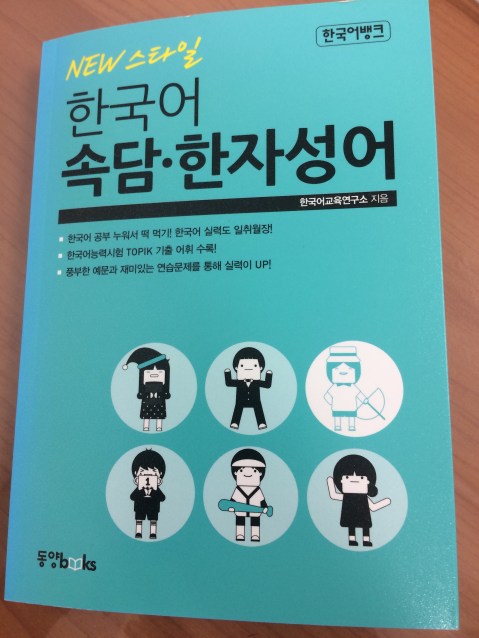
As I’ve written previously that I’ve recently taken a great interest in Chinese characters since they are the roots of the majority of Korean words. There are countless of such four-character expressions, and among the most common expressions I learned at level 5 in Sogang, you’ll hear:
- 一石二鳥 (일석이조) “hitting two birds with one stone”
- 東問西答 (동문서답) “to ask in the east and reply in the west” (my favorite, since we have the same in Danish)
- 雪上加霜 (설상가상) “to make matters worse” lit. adding a layer of ice on top of the snow
- 天生緣分 (천생연분) “a match made in heaven”
- 苦盡甘來 (고진감래) roughly “practice makes perfect”
If you, like me, are interested in Chinese characters, these expressions are excellent for studying their meanings and learning some useful Korean at the same time. The method is truly 一石二鳥 – hitting two birds with one stone. Here’s a handy guide on how to proceed:
- Find a character you want to study, for the sake of the example let’s take 一石二鳥 from before (일석이조) in Korean script.
- Go to the Naver dictionary of Chinese characters
- Type in the expression in Korean and press enter
Here’s a screen shot of what you’ll see:
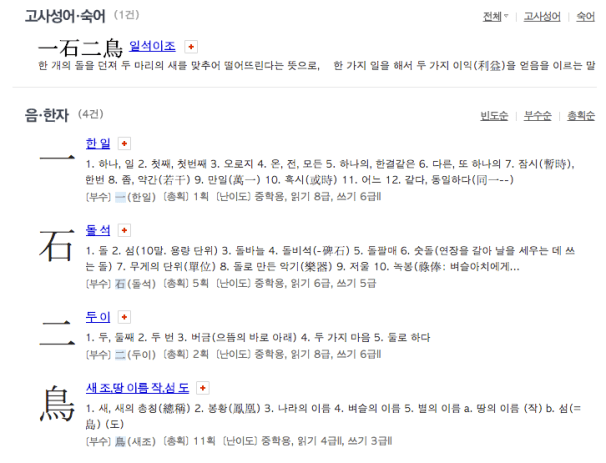
The first line explains the meaning of the whole expression. Below, each character is explained separately. Try clicking on each of the characters. Let’s try the fourth one here, 鳥 (조):
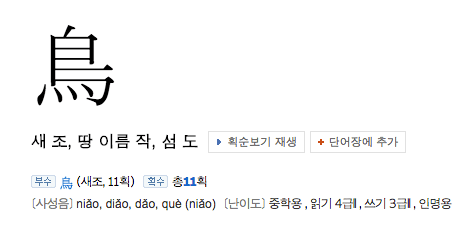
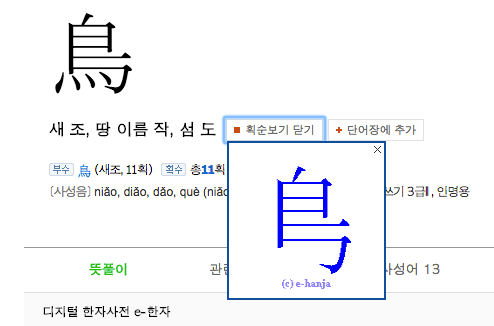
If you click on the blue arrow on the button that reads 획순보기 재생 (view stroke order), you can learn how to write the character.
I hope you find this guide useful. I strongly recommend gaining a good foundation of Chinese characters, even if they are not used in everyday Korean. They will make you feel more confident when you encounter unknown vocabulary, and most importantly, they are fun! Happy studying and feel free to leave any comments or questions below.


 Sofie to Korea
Leave a reply to tlaylay35 Cancel reply