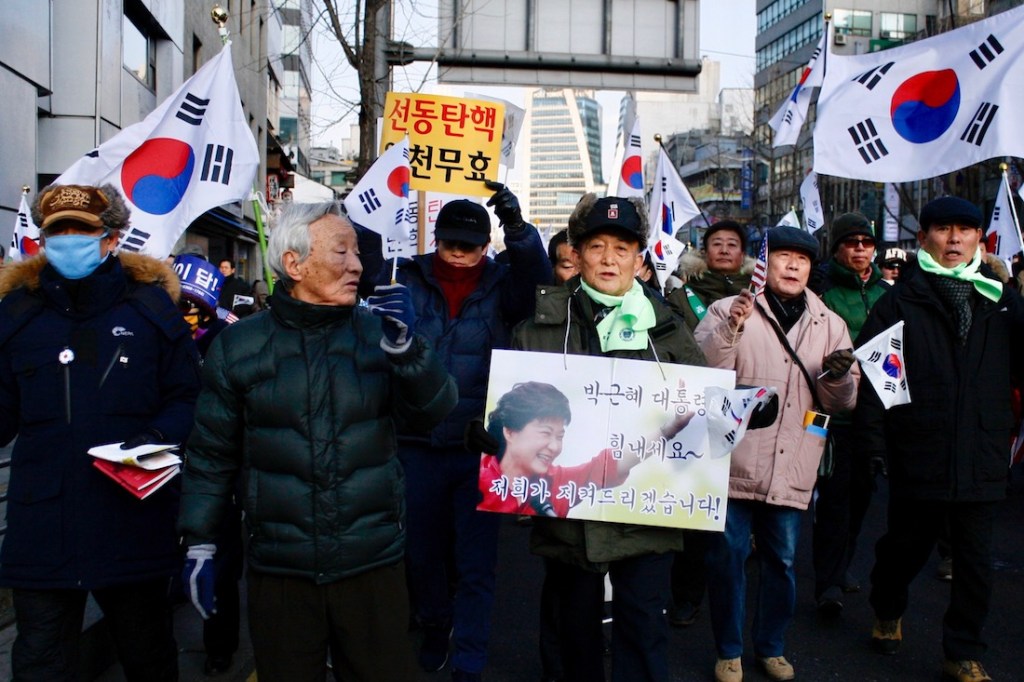
I’m now through my midterms at Sogang, and it’s time for the fourth and final installment of my “introducing the Koreans” series. This time, I’ll be dealing with the Korean ajusshis and I’ve promised my friend Jonson from Spongemind to go easy on them, haha. I’m not sure Jonson quite fits into this category, though. For your reference, ajusshi is a term used to address older Korean men. (I personally usually refrain from using this word and opt for addressing people using their title instead.) I realize that the title picture may seem a bit controversial, but keep reading and hopefully you’ll understand my choice.
As in the other cases, I’ll illustrate this post by introducing examples of ajusshis that I encounter in my daily life. Again, I’m painting with the widest of brushes, so please know that this is just my general experiences, and as always there are plenty of exceptions. I’m also excluding all of my colleagues, my doormen, and basically any kind of well-read, educated, open-minded ajusshi. Instead, in this post, I’m focusing on the ajusshis I meet on the street.
I think it’s safe to say that my experiences with this particular type of Koreans is just as mixed as with the ajummas. The longer I’ve been living in Korea, the better I’ve come to understand them, but there are still some significant cultural differences between myself and elderly Koreans.
I recently read an awesome book by Michael Breen, a British national who’s been living in Korea for over 30 years. The book is called “The new Koreans”, and reading this has really provided me with a deep insight into the cultural heritage of Korea and it’s people. I highly recommend it to anyone who wants to learn more about this amazing and sometimes completely impossible country. Breen writes candidly and often critically, but his love for Korea shines through on every page, and it’s by far the best book I’ve ever read on Korea.
I’ve come to realize that there’s a vast generation gap in Korea, which often causes clashes between the younger and older Koreans. While older Koreans are traditionally more conservative, younger Koreans are open minded, free of prejudices regarding race or sexual orientation, curious about the world, and much more independent than the older generations. There is no doubt that the influx of other cultures into Korea has affected younger people and inspired them to be a bit more individualistic. For example, the concept of family is becoming increasingly narrow among young Koreans. A recently published survey showed that younger people usually only counted their immediate family as real family (spouse’s family was not seen as real family), while older Koreans counted extended family as well. Maybe for that particular reason, the number of young Koreans who choose to live with the husband’s parents after marriage is steeply decreasing.
But this rapid modernization, if you will, of the Korean mindset comes at a heavy cost for the older generation. They are the ones who struggled 70 hour work weeks to build Korea into the prosperous nation that it has become in an unprecedented matter of decades. They are now relying on their children and grandchildren to take care of them, and when their children then decide to live alone, they are left without anyone to take care of them in their old age. This generation of Koreans have suffered a lot of hardship, and they carry a lot of han. When I think of this, I can better understand the sometimes irrational behavior of particularly ajusshis. So, let me tell you about one of my experiences:
The topic of taxi drivers has been covered in a separate blog post before, but I have obviously had many other experiences since then. One particular experience was a couple of months ago, where a 70-something taxidriver was driving me home to my apartment by Sogang. It wasn’t a particularly long trip, but this ajusshi gave me a valuable insight into his daily worries. After having mistaken me for an overseas Korean (it was very dark, and he didn’t see my blond hair), he began telling me about his huge disappointment in his son an daughter-in-law. His son had apparently married a horrible woman, who refused to live with her parents-in-law. The taxidriver lamented that he and his wife had raised his son while struggling to make it through on low-paying jobs. His son now had a well-paying job and wouldn’t even make his wife move in with his parents. Adding insult to injury, they had announced that they would go abroad with their children so that the children could learn English. I’m very familiar with both concepts, but I could tell that the taxidriver was honestly surprised, confused, and hurt. He said that he was afraid that if they stayed abroad for too long, his grandchildren would no longer be able to speak proper Korean. He then turned around and looked at me with a disapproving gaze: “Are you married?” – yes – “Do you take good care of your parent’s in law?” – well… – “What about your parents? Did you just leave them to move here?” – sort of…– “This is exactly this Western influence that’s poisoning our society, but I suppose it’s not all your fault.”
I was overwhelmed and even felt a bit guilty when I got off, but this conversation was a valuable insight into the mind of a segment of the Koreans that I for long have struggled to understand. I used to think that this type of older Korean man was just rude and angry for no reason, but this experience made me realize that we all have our own struggles and that they are often the reason for why we behave as we do.
As many of you may know, Korea is currently undergoing significant political turmoil. A little over a month ago, the Korean supreme court unanimously voted to oust the former president Park based on accusations of bribery and misuse of power for her own and her friend’s benefit. The curious thing about this case, is that Park is the daughter of former dictator General Park, who governed the country from 1961 until his assassination in 1979. Close to 90% of Koreans approved of the court’s decision. In fact, since the scandal started rolling in October, people have taken to the streets of central Seoul every Saturday to show their anger toward Park, demanding her resignation. However, following Park’s ousting, a new type of demonstrators appeared – her supporters. I naively thought that all Koreans wanted her out of the Blue House. But I soon realized that there are some (almost exclusively older Korean men) who see her as the rightful heir to the Korean “throne” being the daughter of the amazing leader General Park, who (despite torture, violence and anti-democratic means) managed to make the Korean economy flourish. They idolize the Park dynasty and want the court to overturn their decision.
If I had just moved here, I would say that these older gentlemen are crazy, but through reading about, and talking with elderly people, I’ve come to at least partly understand why they think the way they do. I’m a firm believer of the “the only thing constant is change” doctrine, so obviously I don’t agree. But I also realize that “understanding” and “agreeing with” are not the same thing. I understand their frustration, their pain, their anger, their han. I don’t agree with them, however, but I don’t view them as critically as I would without my knowledge of Korea and it’s history.
So, when coming to Korea, you may meet the occasional slightly aggressive ajusshi, who may blame you for being young, Western, and married but living independently. He may even speak rudely to you, but try to let it pass. He probably had a harder life than you and face struggles, you cannot begin to imagine. I find that when I smile and speak politely, they usually lower their guards, and if I in any way can help just one person change his perception on foreign influence, I’ll be thankful.


 Sofie to Korea
Leave a reply to 소희 Cancel reply