In my eager to become fluent in Korean the above question has puzzled me for a while. Over the years I’ve learned a great deal of foreign languages, but never in this way (organized self-studying). Gradually acquiring e.g. German from classes in middle through highschool combined with regular trips to Germany, while regularly being exposed to German TV eventually made me fluent. But how long did it take? Back then I didn’t really care – I just learned the language gradually over the years and one day found myself able to carry an intelligent conversation for several minutes.
Korean is a different story. I started studying in late July 2014 and still feel very much like a beginner, though my vocabulary, grammar knowledge and sentence building skills probably should place me in the intermediate category. Nonetheless, I’m far from fluent. Or as the Koreans would say: “아직 멀었어요”.
Yesterday I stumbled across this super inspiring TEDtalk by Chris Lonsdale http://www.youtube.com/watch?v=d0yGdNEWdn0 who claims that any human being holds the ability to acquire fluency in a second language in a mere 6 (six!) months. Needless to say I was very intrigued, and at the same time painfully aware that this is precisely the amount of time that I’ve already spent studying Korean without reaching said proficiency level (sigh…).
Anyway, he had some super interesting points that I think are relevant for all (language) learners. He claims that by knowing 5 key principles and carrying out 7 simple actions, learning a new language is a piece of cake. The 5 principles:
- Focus on language content that is relevant to you. If you want to survive for a week as a tourist in Seoul you should learn how to order food, ask directions, words for public transportation, etc. This is necessary and relevant to you, rendering you much more likely to learn the words and retain them in your memory. You would quickly lose interest if you started out learning Korean biology vocabulary, as it does not have any relevance (yet).
- Use your new language as a tool – from day 1! When you start applying the new words you’ve learned they will stick to your brain. Babies who first start talking do the exact same thing. They hear a word, they learn it, and they repeat it. This principle is key to language comprehension.
- When you first understand the message – you will unconsciously acquire the language. When you train your listening comprehension you should focus on what you DO understand rather than what you DON’T understand. Imagine someone saying to you: #”!§?]&%#. Q@{|%& hungry $”!£}]´/ *(%$¤#!-> £@%&[+} food? Well, you certainly didn’t understand the entire sentence, but you understood “hungry” and “food”. In connection with the speaker’s body language you correctly deduct that the entire sentence was: “I’m starting to get a bit hungry, so what do you say we grab some food?”
- Comprehension is key and can in many ways be compared to physical training. The more you listen, the more you’ll understand. In the same way, the more you practice speaking the more natural your foreign language will sound.
- Psycho-physiological state matters. When you are happy and relaxed you will learn faster with less effort. If your mind is elsewhere… Well, that makes sense.
And now for the 7 actions that should put us all on the highroad to fluency:
-
Practise listening (a lot). Though you may be geographically far from the country of your target language, the internet is a goldmine for finding listening material – especially in Korean. Of course you can listen to songs, but for Korean listening comprehension training I personally turn to the educational and fun Iyagi (이야기) lessons at http://www.talktomeinkorean.com. These are natural conversations in Korean about all kinds of everyday topics including rainy days, travel, exercise, and much more.
- Focus on getting the meaning. A holistic approach will get you much farther than focusing on each single piece of vocabulary. Don’t worry if you don’t understand every single bit, as long as you understand the message.
- Start mixing! If you have 10 nouns, 10 verbs, and 10 adjectives you’ll be able to construct 1000 sentences. They won’t all make sense but you are sure to have fun in the process. In fact, my favorite grammar podcast from TalkToMeInKorean are their Sentence building drills where they present three key sentences and demonstrate how they can be changed into many different sentences. See an example here: http://www.talktomeinkorean.com/lessons/level-5-lesson-20/
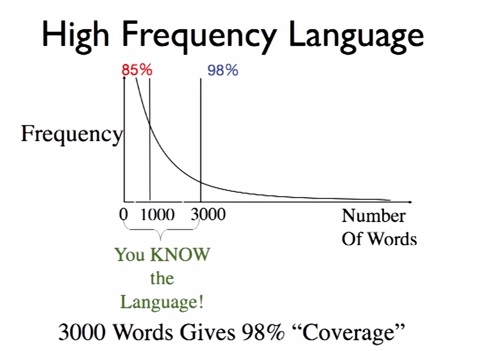
- Focus on the core. My personal favorite as it sounds so promising: According to Lonsdale approximately 85% of all things you say in a day in any language can be covered by the 1000 most frequently used words. 98% of all daily speech is covered by the most frequently 3000 words, and if you know them, you KNOW the language. For training and memorizing the 1000 most frequently used Korean words, check out this site: http://www.memrise.com/course/1614/1000-most-common-korean-words/
- Find a language parent. Team up with a native speaker who will kindly speak to you like a parent to a child meaning that they will not correct your mistakes but rather talk to you in a simple everyday language using words that you can easily understand. This will encourage you, promote fluency, and help you to expand your vocabulary.
- Copy the facial expressions of native speakers. This will make you more easily understood by native speakers.
- Use the “direct-connect” principle for retaining vocabulary. Though I’m not personally against pure memorization and flash cards, I admit that I oftentimes end up forgetting simple vocabulary that I’ve spent a lot of time memorizing. I find that the words stick better in my brain when I manage to connect them to images, situations, or people, and this is exactly the idea behind the “direct-connect” principle. Simply store a new word in your brain by associating it with as many images of the word that you possibly can and it will stick.
Whoa, that was a long post. But I feel quite strongly about this topic, as fast learning has always been an interest of mine. I encourage you to go on and watch the youtube video of the talk and share your thoughts below.


 Sofie to Korea
Leave a reply to Inspiration for getting the most out of your language exchange | Sofie to Korea Cancel reply